
Candle Wax Calculator
Work out exactly how much wax to melt. Enter the water capacity of your container and how many candles you are making; the calculator converts to wax weight, adds a little for pour loss and tells you how much fragrance oil to weigh out.
- Free to use
- No sign-up
- Runs in your browser
Calculate candle wax
Candle Batch Workbook
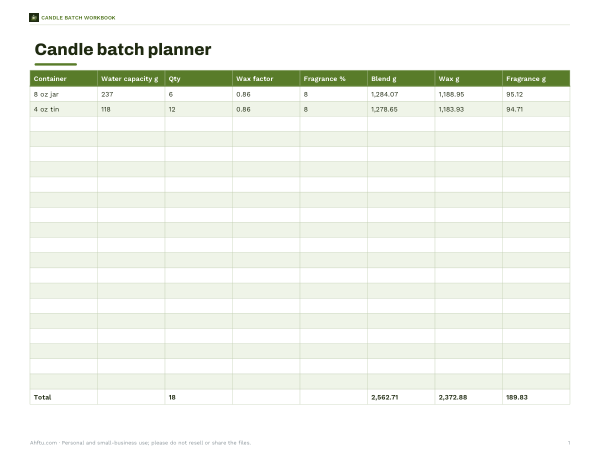
Plan batches, cost every candle, log test burns and scale recipes — a workbook built for small candle businesses and hobbyists.
- Batch & cost workbook (XLSX, PDF)
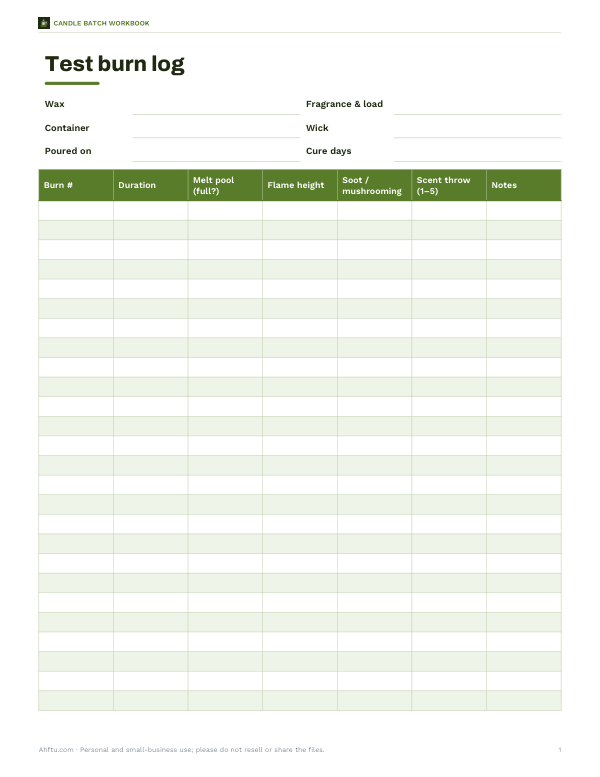
- Test burn log (PDF, DOCX)
Formats: XLSX, PDF, DOCX. Instant download after payment (link valid 72 hours, up to 5 downloads). AI-assisted: the templates were drafted with AI help and reviewed and laid out before publishing.
$5.00 USD, one-time
- Instant download
- 7-day refund
- Secure checkout by Stripe
7-day money-back guarantee. Full refund within 7 days of purchase, even after you download.
Full refund within 7 days — see the refund policy and license.
Free printables
Single sheets you can print right now, no sign-up. The full pack adds every sheet in one download plus the editable files.
Why candle wax is measured by weight
Candle makers weigh wax rather than measuring it by volume, because solid wax flakes or pellets pack loosely and change volume as they melt. The container, however, is usually described by volume: an “8 oz jar” often holds about 8 fluid ounces of water, but wax is lighter than water, so it holds only around 7 ounces of wax by weight. The calculator bridges that gap. Fill your container with water to the level where the wax will stop, measure that water — by volume or by weighing it — and the calculator converts it to the weight of wax.
The formula
- Water capacity in grams (1 ml of water weighs about 1 g; 1 US fl oz is 29.57 ml).
- Candle blend per container = water capacity × wax density factor. Most container waxes are about 0.86–0.9 times the density of water; beeswax is denser, around 0.96.
- Batch blend = blend per container × number of candles × (1 + pour-loss allowance).
- Wax = batch blend ÷ (1 + fragrance load). Fragrance = batch blend − wax.
Calculating the fragrance as a percentage of the wax weight is the most common convention among candle makers and fragrance suppliers. Some makers use a percentage of total weight instead; the difference is small at typical loads but worth knowing when you compare recipes.
Worked example
Six jars each hold 8 US fl oz of water to the fill line — about 237 ml. With soy wax at a factor of 0.86, each jar takes about 203 g of wax and fragrance combined. Six jars need 1,221 g, and adding 5% for pour loss and a top-off pour gives about 1,282 g. With an 8% fragrance load, that is 1,187 g of wax (about 2.6 lb) and 95 g of fragrance oil (about 3.4 oz). Weigh both on a digital scale.
Measuring container capacity
- Place the empty container on a kitchen scale and tare it to zero.
- Fill it with water to where the wax surface will be — usually about half an inch (1–1.5 cm) below the rim.
- Read the weight in grams or ounces; that is the water capacity by weight.
- Dry the container completely before pouring wax; water causes spitting and poor adhesion.
- If all your containers are identical, measure one; if they vary, measure a few and use the average.
Pour loss and top-offs
Some wax always stays in the pouring pitcher, on thermometers and on spills, and many waxes sink around the wick as they cool, needing a small second pour to level the surface. Adding 5–10% to the batch covers this. Making extra and pouring the remainder into a small tin or wax-melt clamshell is better than running short mid-pour, when the last candle would have a different temperature and fragrance mix.
Choosing a fragrance load
Fragrance load is the amount of fragrance oil relative to wax. Most container waxes hold between 6% and 10%; some accept up to 12%. More fragrance does not always mean a stronger scent throw — overloading can cause oil to seep, poor burning and soot. Check the maximum on your wax's technical data sheet and the fragrance supplier's recommended maximum for candles, and use the lower of the two. For a new wax and fragrance pairing, test at a few loads, such as 6%, 8% and 10%, and compare after a full cure.
Typical wax and container figures
| Container | Water capacity | Wax + fragrance (approx., soy) |
|---|---|---|
| 4 oz tin | ≈4 fl oz / 118 ml | ≈3.6 oz / 102 g |
| 8 oz straight-sided jar | ≈8 fl oz / 237 ml | ≈7.2 oz / 204 g |
| 9 oz tumbler | ≈9 fl oz / 266 ml | ≈8.1 oz / 229 g |
| 12 oz tumbler | ≈12 fl oz / 355 ml | ≈10.8 oz / 305 g |
| 16 oz jar | ≈16 fl oz / 473 ml | ≈14.4 oz / 407 g |
Melting and pouring basics
Melt wax in a double boiler or dedicated wax melter, never directly over a flame, and use a thermometer. Add fragrance at the temperature your wax supplier recommends — often around 185 °F (85 °C) for soy — and stir gently for a couple of minutes so it binds with the wax. Let the wax cool to the pouring temperature on the data sheet before pouring. Keep a fire extinguisher suitable for grease fires nearby, never leave melting wax unattended, and let candles cure for the recommended time — often one to two weeks for soy — before test-burning.
Wick sizing and test burns
The wick matters as much as the wax amount. A wick that is too small tunnels down the middle; one that is too large produces a tall flame, soot and a container that gets too hot. Wick suppliers publish charts by container diameter and wax type, but every wax, fragrance and dye combination behaves a little differently, so test-burn before selling or gifting. Burn a test candle for about one hour per inch of diameter on the first light so the melt pool reaches the edge, and keep notes of wick, load and results in a batch log.
Frequently asked questions
How much wax do I need for an 8 oz candle?
About 7 oz (roughly 200 g) of soy wax and fragrance combined for a jar that holds 8 fl oz of water. Measure your jar to be sure.
Why does my jar hold less wax than water?
Wax is less dense than water — about 0.86 times for most container waxes — so the same volume weighs less.
Should fragrance be a percentage of wax or total weight?
Most suppliers quote fragrance load as a percentage of wax weight, which is how this calculator works.
How much fragrance oil per pound of wax?
At 8%, about 1.3 oz of fragrance per pound (16 oz) of wax; at 10%, 1.6 oz.
Can I reuse leftover wax?
Yes. Pour extra into tins or wax-melt moulds, or label it with the fragrance and remelt it for top-offs.
Does dye change the wax amount?
No meaningful amount. Liquid dye or dye chips are used in very small quantities.